Geotechnical Engineering
DUBLIN
HomeLaboratoryEnsayo CBR de laboratorio

Laboratory CBR Testing in Dublin for Pavement Design and Subgrade Assessment

Site investigations you can build on.

LEARN MORE

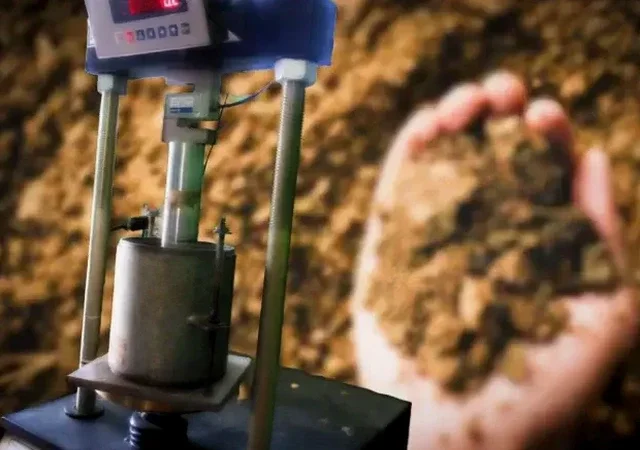
A recent upgrade of a bus corridor near the Grand Canal Dock required precise subgrade evaluation before the asphalt could be laid. The contractor faced Dublin’s notoriously variable glacial till, where bearing capacity can shift within metres. Our laboratory performed a soaked CBR test on remoulded samples compacted at the expected site density, simulating the worst-case moisture scenario that Dublin’s damp climate presents year-round. The data fed directly into the pavement thickness design, avoiding over-engineering the capping layer while safeguarding against rutting. For projects where the in-situ material varies, we often pair the laboratory CBR with a field CBR assessment to correlate lab values with actual ground response.

A soaked CBR value below 2% demands either soil stabilisation or a complete capping replacement — there is no middle ground in pavement design.
Process overview

Dublin’s maritime climate, with over 750 mm of annual rainfall and persistently high humidity, means that subgrade soils rarely remain at optimum moisture content. A CBR test run on a sample at natural water content can give a misleadingly high value if not followed by a soaked procedure. Our laboratory replicates these conditions by immersing compacted specimens in water for 96 hours, measuring swelling and then penetrating the sample at a controlled rate of 1.27 mm per minute. The load-penetration curve is corrected for surface irregularities, and we report the CBR at both 2.5 mm and 5.0 mm penetration. When the subgrade includes fine-grained boulder clay typical of north Dublin, we recommend running a grain-size analysis alongside to confirm the fines content, since soils with more than 35% passing the 63-micron sieve behave differently under saturation.
Laboratory CBR Testing in Dublin for Pavement Design and Subgrade Assessment
Technical reference — Dublin

Local context

With Dublin’s population exceeding 1.4 million in the Greater Dublin Area, infrastructure projects face intense pressure to minimise lane closures and traffic disruption. A subgrade that passes visual inspection but yields a laboratory CBR below the design threshold becomes a costly discovery if identified after paving. We have seen cases on the M50 widening where untreated boulder clay with a soaked CBR of 1.5% led to premature fatigue cracking within two winters. The laboratory CBR test eliminates this guesswork by providing a repeatable, standardised value that the pavement engineer can use directly in the Transport Infrastructure Ireland design catalogue. Skipping this step on a commercial car park or an industrial yard in a high-rainfall zone like Tallaght or Blanchardstown risks bearing failures that are five times more expensive to remediate than to prevent.

Need a geotechnical assessment?

Reply within 24h.

Email: [email protected]

Reference standards


IS EN 13286-47:2021 — Unbound and hydraulically bound mixtures, Part 47: Test method for the determination of California bearing ratio, IS EN 13286-2 — Test methods for the determination of density and water content, TII CC-SPW-01200 — Transport Infrastructure Ireland Specification for Road Works, Series 600: Earthworks, BS 1377-4:1990 — Soils for civil engineering purposes, compaction-related tests (referenced for procedural guidance)

Technical data

ParameterTypical value
Applicable standardIS EN 13286-47:2021 (Irish adoption of EN 13286-47)
Specimen compactionProctor hammer, 62 blows per layer, 3 layers
Soaking period96 hours submerged under a 4.5 kg surcharge
Penetration rate1.27 mm/min ±0.15 mm/min
Surcharge ringsAnnular weights simulating 100-200 mm of pavement structure
Swelling measurementRecorded every 24 hours during soaking with 0.01 mm precision
Reported valuesCBR at 2.5 mm and 5.0 mm penetration, corrected curve, swell percentage

Common questions


What does a laboratory CBR test cost in Dublin?

A standard soaked CBR test on a remoulded sample ranges between €110 and €170 per specimen, depending on whether a Proctor moisture-density curve is required beforehand. The price includes compaction, soaking, penetration, curve correction, and a signed test report. Volume discounts apply for projects submitting four or more specimens in a single batch.

How long does it take to get CBR results from your Dublin lab?

The standard turnaround is 5 to 7 working days from sample receipt. The soaking phase alone requires 96 hours under water before penetration can proceed. For emergency utility reinstatements or urgent pavement openings, we offer an expedited service with results in 3 working days, subject to laboratory capacity.

Why is the soaked CBR value lower than the unsoaked one?

Dublin’s fine-grained tills lose suction and soften when saturated. During the 96-hour soaking period, water fills the pore spaces and reduces effective stress between particles. The plunger then displaces the soil more easily, producing a lower load reading at 2.5 mm and 5.0 mm penetration. The soaked value represents the worst-case condition after prolonged rainfall or a rising water table, which is the design scenario required by TII specifications.

Can you test samples collected from our site or do we need to bring them in?

We accept both options. You can deliver bag samples or undisturbed cores to our laboratory in Dublin, following our sampling guide for minimum quantity. Alternatively, we can arrange collection from your site within the Greater Dublin Area, including satellite towns like Swords, Lucan, or Dún Laoghaire. Remoulded specimens require approximately 6 kg of material passing the 20 mm sieve.

Location and service area

We serve projects across Dublin and surrounding areas.

View larger map
er>