Geotechnical Engineering
DUBLIN
HomeLaboratorysoil mechanics investigation

Geotechnical Engineering in Dublin

Site investigations you can build on.

LEARN MORE

Dublin's geology presents a marked contrast between the resistant granite of the Wicklow Mountains to the south and the complex Quaternary deposits underlying the city centre. Glacial till —locally known as boulder clay— dominates much of the urban area, a stiff, overconsolidated material of highly variable composition that demands a rigorous soil mechanics study before any construction project. The proximity to the River Liffey and its tributaries introduces layers of alluvial silts and soft clays in areas like Docklands, where bearing capacity can drop significantly. A comprehensive soil mechanics study in Dublin must characterize the strength, compressibility, and drainage behaviour of these materials, applying EN 1997-2:2007 procedures and laboratory testing to derive reliable design parameters. Our laboratory processes samples from across the metropolitan area, from Blackrock to Blanchardstown, generating the triaxial, oedometer, and classification data that structural engineers require for safe, economical foundations.
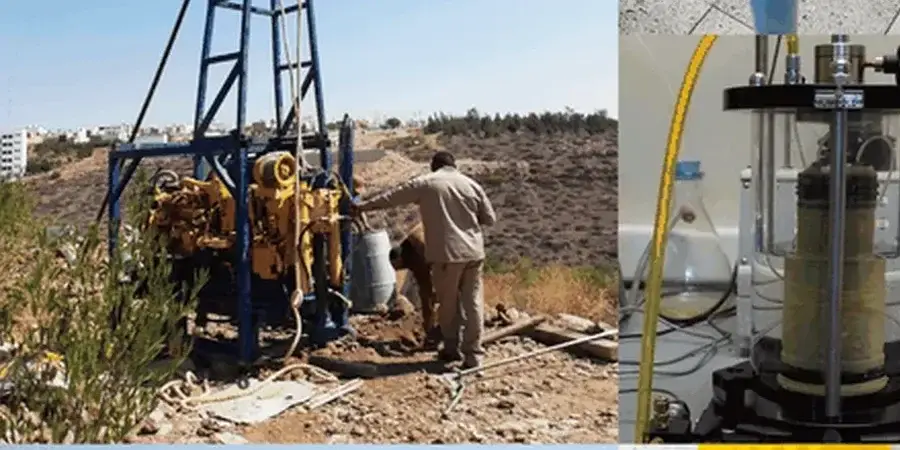
Illustrative image of Soil mechanics study in Dublin
Dublin's boulder clay offers excellent bearing capacity —often exceeding 300 kPa— but its variability over short distances makes site-specific testing indispensable for any project.

Process overview

A recent project on a former industrial site near the Grand Canal involved a five-storey mixed-use building where preliminary boreholes revealed 4 metres of made ground overlying Dublin boulder clay. The developer needed a triaxial test programme to define the effective shear strength parameters of the clay for a retaining wall design, and a grain-size analysis to assess drainage requirements behind the proposed structure. The soil mechanics study included consolidated-undrained triaxial tests with pore pressure measurement on Shelby tube samples recovered at depths between 6 and 14 metres, giving c' values of 5 to 15 kPa and φ' between 28° and 34°. Oedometer tests on the same material indicated overconsolidation ratios above 8, consistent with the glacial history of the Dublin basin. This information allowed the design team to optimize the foundation depth and confirm that settlements would remain within the 25 mm serviceability limit specified for the structural frame.
Geotechnical Engineering in Dublin
Technical reference — Dublin

Local context

On Dublin's northside, we repeatedly encounter a situation where boulder clay appears competent in the upper few metres but conceals lenses of water-bearing sand or silt at depth. Excavations that intersect these lenses without prior identification in a soil mechanics study can experience base instability or rapid inflow, particularly when working below the water table which in Dublin is typically within 2 to 3 metres of the surface. A second risk involves pyrite-bearing mudstones and shales of the Carboniferous Calp formation, present beneath the Quaternary cover in parts of the city. These materials can swell on exposure to air and moisture, generating heave pressures that have damaged lightly-loaded floor slabs and services. The soil mechanics study must include swelling tests and chemical analysis when these strata are encountered, following the recommendations of I.S. EN 1997-2 and the Institution of Structural Engineers guidance on pyritic ground.

Need a geotechnical assessment?

Reply within 24h.

Email: [email protected]

Reference standards


I.S. EN 1997-1:2004 (Eurocode 7: Geotechnical design — General rules), I.S. EN 1997-2:2007 (Eurocode 7: Ground investigation and testing), BS 5930:2015+A1:2020 (Code of practice for ground investigations), BRE Special Digest 1:2005 (Concrete in aggressive ground), I.S. EN ISO 17892 series (Geotechnical laboratory testing)

Technical data

ParameterTypical value
Typical depth of boulder clay in Dublin city centre3 to 15 m below ground level
Undrained shear strength (cu) of Dublin boulder clay80 to 250 kPa
Effective friction angle (φ') from CIU triaxial27° to 35°
Overconsolidation ratio (OCR)6 to 15
Permeability of intact boulder clay1×10⁻⁹ to 1×10⁻¹¹ m/s
Swell pressure in weathered shale (Docklands)50 to 200 kPa
Sulphate class (BRE SD1) in made groundDS-1 to DS-3
Standard penetration test N-value (boulder clay)25 to >50

Common questions

What does a soil mechanics study in Dublin typically cost for a residential project?

For a standard single-house or small residential development in Dublin, a soil mechanics study including trial pits or boreholes, classification testing, and a factual report with basic design parameters generally ranges from €2,630 to €4,730, depending on access conditions and the number of samples tested. Sites requiring deeper investigation or specialist testing such as triaxial or chemical analysis will fall toward the upper end of this range.

How deep should a ground investigation go for a Dublin basement excavation?

For a single-level basement in Dublin, the investigation should extend to at least 1.5 times the excavation depth below the formation level, and deeper if the preliminary soil mechanics study indicates soft alluvium or sand lenses beneath the boulder clay. In practice, this often means boreholes to 8 or 10 metres for a standard 3-metre basement, with piezometers installed to monitor groundwater response during dewatering.

Is Dublin boulder clay suitable for spread foundations?

Yes, Dublin boulder clay generally provides excellent bearing capacity for spread foundations, with allowable bearing pressures commonly in the range of 200 to 400 kPa at depths of 1.5 to 2 metres. However, the soil mechanics study must verify that the clay is continuous and free of soft inclusions, and that the design depth places the footing below the zone of seasonal moisture variation and frost action.

Location and service area

We serve projects across Dublin and surrounding areas.

View larger map