Geotechnical Engineering
DUBLIN
HomeLaboratoryEnsayo triaxial

Triaxial Testing for Soil Strength in Dublin

Site investigations you can build on.

LEARN MORE

In Dublin, the first thing you notice when digging below the surface is the boulder clay, a dense, over-consolidated glacial till that covers most of the city basin. We know it well; our team has pulled samples from sites along the Liffey quays to the suburbs of Tallaght where the ground shifts from stiff clay to weathered limestone bedrock in less than three meters. Before anyone pours a foundation or designs a retaining wall in this city, you need more than a simple SPT number. You need the full stress-strain envelope that only a triaxial cell can deliver. The test gives us undrained shear strength, effective friction angle, and deformation modulus under conditions that replicate the actual field confining pressures. For Dublin's variable drift geology, we frequently combine triaxial results with grain-size data to separate the silty clays from the well-graded sands, and with atterberg-limits to confirm the plasticity range of the cohesive matrix, because misclassifying a low-plasticity silt as a clay can lead to a completely different set of design parameters.
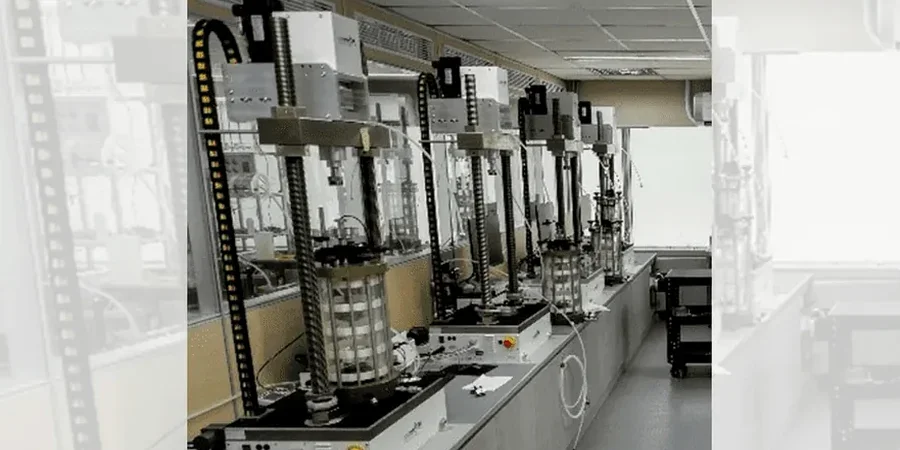
Illustrative image of Triaxial test in Dublin
A triaxial test on Dublin boulder clay gives you the full story: effective friction angle, cohesion intercept, and undrained shear strength from one specimen under site-specific confining stress.
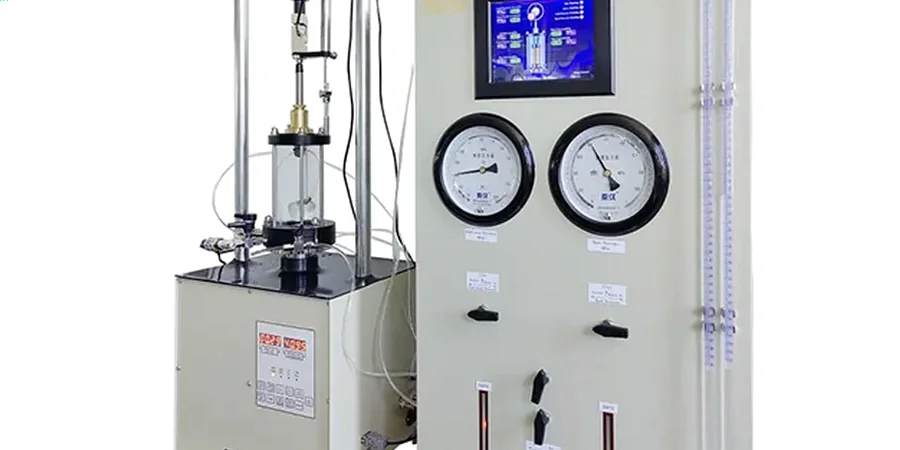
Process overview

The triaxial cell in our Dublin facility is a stiff loading frame capable of applying confining pressures up to 2 MPa, which covers the stress levels you'd encounter at basement depths in the Grand Canal Dock area or for deep pile caps in the Docklands. The setup includes a digital pressure-volume controller for precise back-pressure saturation, and local LVDTs mounted directly on the specimen to eliminate bedding errors and machine compliance. For Dublin boulder clay, we typically run consolidated-undrained (CU) tests with pore pressure measurement, because that gives you both total and effective stress parameters in one go. You get the Mohr-Coulomb envelope, the secant modulus at 50% strain, and the Skempton pore pressure coefficient at failure. When the project requires deformation parameters for deep-excavations—say, a cut-and-cover tunnel or a multi-level basement near the Dodder—we run small-strain measurements with bender elements to capture Gmax, the maximum shear modulus, before the sample even sees shear. This level of detail matters in Dublin, where the till can be fissured and its stiffness depends heavily on the confining stress and the presence of occasional gravel lenses.
Triaxial Testing for Soil Strength in Dublin
Technical reference — Dublin

Local context

Comparing two Dublin sites shows why the triaxial test is non-negotiable. In Blackrock, the ground is typically a stiff, sandy gravelly clay with high effective friction angles—often above 33 degrees—and low compressibility. A shallow pad footing here works fine with conservative bearing pressures. But move north of the Liffey to the alluvial deposits near the Tolka River, and you hit soft silty clays with organic content, where the undrained shear strength can drop below 40 kPa. If you rely on a correlation from SPT blow counts instead of direct triaxial measurement, you risk overestimating the bearing capacity by a factor of two. That's how a routine three-storey apartment block ends up with differential settlement cracks in the first winter. The triaxial test quantifies the strength anisotropy too: the undrained strength ratio Su/σ'v varies with stress history, and in Dublin's over-consolidated till, it's not the textbook 0.22 for normally consolidated clays. We have measured values up to 0.45 in samples extracted from the upper crust of the till, which changes the whole slope stability calculation for an excavation-monitoring plan.

Need a geotechnical assessment?

Reply within 24h.

Email: [email protected]

Reference standards


I.S. EN ISO 17892-9: Standard Test Method for Consolidated Undrained Triaxial Compression Test for Cohesive Soils, ASTM D7181-20: Method for Consolidated Drained Triaxial Compression Test for Soils, I.S. EN ISO 17892-8: Standard Test Method for Unconsolidated-Undrained Triaxial Compression Test on Cohesive Soils, Eurocode 7 (EN 1997-2:2007, Section 5): Laboratory testing for geotechnical design, ISRM Suggested Methods for rock triaxial testing (when testing Dublin calp limestone)

Technical data

ParameterTypical value
Test standardsI.S. EN ISO 17892-9 (CU), ASTM D7181 (CD), I.S. EN ISO 17892-8 (UU)
Specimen diameter50 mm to 100 mm, depending on maximum particle size in the Dublin till
Maximum confining pressure2000 kPa (covers basement and deep excavation depths in Dublin)
Back-pressure saturationUp to 1000 kPa, with Skempton B-value check > 0.95
Strain rate for CU tests0.02%/min to 0.1%/min, based on consolidation coefficient Cv
Reported parametersc' and φ', effective cohesion and friction angle; Su, undrained shear strength; E50, secant modulus
Sample preparationTrimmed from Shelby tube samples extracted from Dublin boulder clay units

Common questions


What is the typical turnaround time for a triaxial test programme in Dublin?

A standard set of three CU triaxial tests on Dublin boulder clay takes approximately 8 to 10 working days from sample arrival to final report, including consolidation and shear stages plus data reduction. If you need small-strain measurements with bender elements, add two days for setup and calibration.

How much does a triaxial test cost for a Dublin project?

A complete triaxial testing programme typically ranges from €1.820 to €2.430, depending on the number of specimens, test type (CU, CD, or UU), and whether small-strain or cyclic loading modules are required. We provide a fixed-price quote after reviewing the borehole logs and sample quality.

Can you test the Dublin boulder clay if it contains gravel and cobbles?

Yes, but specimen diameter must be at least six times the maximum particle size per I.S. EN ISO 17892-9. For the typical Dublin till with occasional gravel up to 20 mm, we use 100 mm diameter specimens. If larger cobbles are present, we trim around them or recommend a 150 mm specimen. We always discuss sample limitations before testing.

Do you need in-situ stress data from the borehole to set up the triaxial test?

Absolutely. We need the depth, groundwater level, and total unit weight from the borehole log to calculate the in-situ effective stress for each specimen. With that, we set the consolidation pressure to match the field stress history. For Dublin's over-consolidated till, we often consolidate to 1.5 to 2 times the in-situ vertical effective stress to capture the preconsolidation pressure effect on strength.

Location and service area

We serve projects across Dublin and surrounding areas.

View larger map
er>