Geotechnical Engineering
DUBLIN
HomeIn-SituPermeabilidad en campo (Lefranc/Lugeon)

Field Permeability Testing (Lefranc/Lugeon) in Dublin

Site investigations you can build on.

LEARN MORE

Dublin's foundation conditions tell a story shaped by ice. Beneath the city streets, a complex legacy of glacial till, fluvio-glacial gravels, and the dark Dublin Boulder Clay controls how water moves through the ground. Anyone excavating a basement in Ballsbridge or designing a SuDS drainage system in Clontarf faces a straightforward question: how permeable is the soil right here, right now? A desk study will not answer that. The local geology varies sharply over short distances, and assumptions about hydraulic conductivity can prove expensive. That is where the team runs in-situ Lefranc and Lugeon tests, capturing water flow data directly from the strata. Before committing to a dewatering strategy, it is often wise to combine permeability data with an SPT drilling campaign to log the sequence of stiff clays and lens-like sand pockets that define Dublin's drift geology.

A single in-situ Lefranc test in Dublin Boulder Clay is worth a dozen lab permeameter runs when designing a construction dewatering system.
Process overview

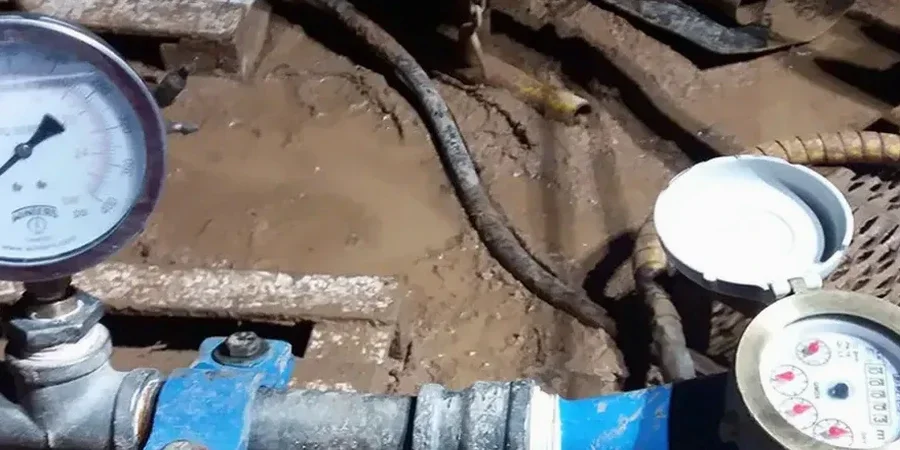
The Lefranc test setup in Dublin typically deploys a slotted standpipe installed within a borehole, sealed with a bentonite packer to isolate a specific horizon. Water is introduced or allowed to fall, and the rate of head dissipation is measured. In the dense, stony tills of south Dublin, the constant-head variant often proves more practical, as falling-head tests would take far too long in low-permeability clay matrices. For bedrock assessments in the granite outcrops near Dún Laoghaire or the Carboniferous limestones under the city centre, the Lugeon method applies packer-sealed pressurised water injection directly into the rock mass. A pressure gauge at the collar records the Lugeon value, which directly informs grouting decisions. Many projects benefit from linking the test results to a grain size analysis of the same horizon, because Dublin Boulder Clay often contains a bimodal mix of silt and cobbles that skews lab-derived permeability estimates compared to field-scale behaviour.
Field Permeability Testing (Lefranc/Lugeon) in Dublin
Technical reference — Dublin

Local context

The risk profile changes dramatically between Dublin 4 and Dublin 22. In the low-lying, reclaimed docklands around Grand Canal Dock, high groundwater in alluvial gravels can flood an excavation within hours if permeability is underestimated. A contractor who assumes the dense clay found in Sandyford will encounter loose, water-bearing gravels in the quays area and face a completely different dewatering challenge. Conversely, in the hillside developments of Kilternan, fractured granite can produce preferential flow paths that a standard Lefranc test in overlying till would entirely miss. The Lugeon test becomes the only reliable way to quantify those discrete fracture flows. Combining permeability data with a slope stability analysis is particularly relevant where cut slopes in weathered rock are planned, because pore pressure distribution directly controls the factor of safety during and after rainfall events.

Need a geotechnical assessment?

Reply within 24h.

Email: [email protected]

Reference standards


BS 5930:2015 + A1:2020 — Code of practice for ground investigations, Eurocode 7 (EN 1997-2:2007) — Ground investigation and testing, IS EN ISO 22282-2:2012 — Geotechnical investigation and testing — Geohydraulic testing — Water permeability tests in a borehole using open systems, Irish Building Regulations, Technical Guidance Document A (Structure)

Technical data

ParameterTypical value
Test StandardBS 5930:2015 + A1:2020 / Eurocode 7 (EN 1997-2)
Test TypesLefranc (constant/falling head) in soil; Lugeon (packer test) in rock
Measured ParameterHydraulic conductivity k (m/s) / Lugeon value (LU)
Borehole DiameterTypically NQ (75.7 mm) to HX (99.2 mm) depending on target depth
Packer TypeSingle or double pneumatic packer for bedrock Lugeon testing
ReportingField data sheets, time-drawdown plots, k-value summary table
AccreditationINAB ISO/IEC 17025 accredited laboratory oversight

Common questions


What does a field permeability test cost in Dublin?

A single Lefranc test in a soil borehole typically ranges from €600 to €850, while a Lugeon packer test in rock runs approximately €720 to €1010, depending on borehole depth, access constraints, and the number of test intervals. Mobilisation and traffic management in Dublin city centre zones can influence the final figure.

When do I need a Lugeon test instead of a Lefranc test?

The Lugeon test is designed for rock mass permeability assessment. If the site investigation encounters competent limestone or granite bedrock beneath the overburden, a Lugeon test with a packer system is the correct method. The Lefranc test is strictly for soils and will not yield meaningful data in fractured rock.

How long does an in-situ permeability test take on a Dublin site?

A single Lefranc test interval, once the borehole is advanced and the standpipe is placed, usually requires one to two hours to reach steady-state conditions in granular soils. In low-permeability Dublin Boulder Clay, a falling-head test may need three to four hours of monitoring. A multi-stage Lugeon test in bedrock can take a full day.

Location and service area

We serve projects across Dublin and surrounding areas.

View larger map