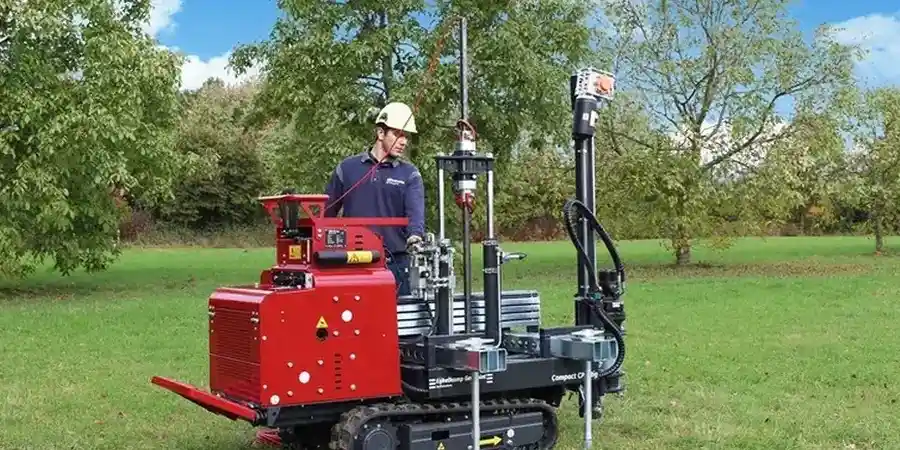
The Irish National Annex to IS EN 1997-2:2007 explicitly recognizes the cone penetration test as a primary site investigation method, and in Dublin's complex glacial and post-glacial geology, it is often the only reliable way to profile soft deposits without disturbing the sample. From the stiff Dublin boulder clay that underlies much of the city centre to the alluvial silts along the Liffey and Tolka estuaries, we have seen firsthand how a single CPT sounding can replace multiple boreholes when the stratigraphy is layered and variable. Our accredited laboratory processes the data following ISO 22476-1, providing continuous profiles of cone resistance, sleeve friction, and pore pressure that feed directly into bearing capacity and settlement calculations. For projects where the till transitions into loose sands at depth, we often combine the CPT with a seismic refraction survey to map the bedrock interface without additional drilling.
A single CPT sounding in Dublin boulder clay can deliver continuous stratigraphy, undrained shear strength, and consolidation parameters without removing a single sample from the ground.