Geotechnical Engineering
DUBLIN
HomeInvestigationSondaje SPT (Standard Penetration Test)

SPT (Standard Penetration Test) in Dublin for Foundation Design

Site investigations you can build on.

LEARN MORE

Dublin sits at the mouth of the River Liffey, where the underlying geology shifts from Carboniferous limestone in the city centre to the granite of the Wicklow Mountains foothills. With an average elevation of just 20 metres above sea level and extensive deposits of glacial till, getting reliable penetration resistance data is not optional—it determines whether your foundation design works. Our team executes the SPT (Standard Penetration Test) strictly to BS EN ISO 22476-3, using automatic trip hammers calibrated for consistent 63.5 kg blows over 760 mm drop. For projects near Dublin Port on soft alluvial clays, we often pair the SPT with a CPT test to capture continuous tip resistance and pore pressure profiles without disturbing the sample, giving the structural engineer a complete ground model before any concrete is poured.

A single SPT blow count in Dublin boulder clay tells you more about tomorrow’s excavation than a week of desk study.
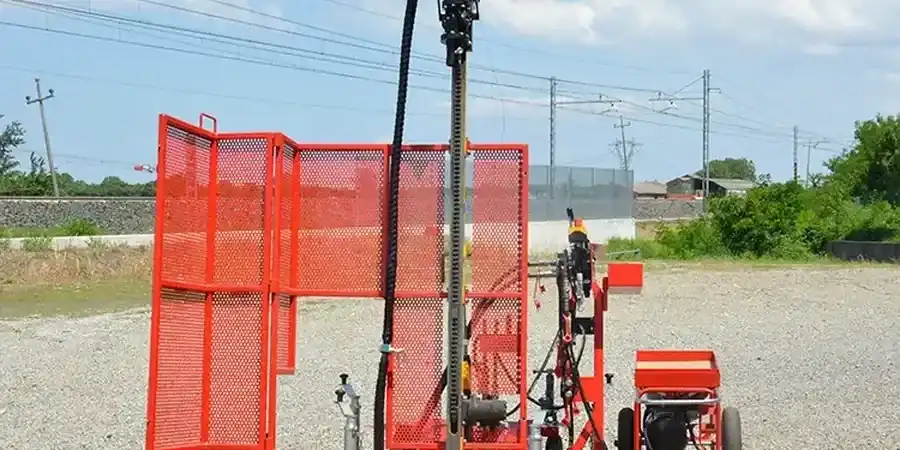
Process overview

In Dublin, we frequently encounter lodgement till that reads high N-values on the SPT sampler but masks cobble-sized clasts that can damage split spoons. That’s why we log every 300 mm penetration increment and record blow counts for seating and test drives separately. The test advances a 51 mm OD split-barrel sampler using a standard 63.5 kg hammer; we count blows per 150 mm over a total 450 mm drive, reporting N as the sum of the second and third increments. Our drillers use hollow-stem augers through Made Ground and rotary coring into bedrock to keep the borehole stable. Every SPT run is supervised by an engineering geologist who classifies the recovered sample on site per BS 5930:2015+A1:2020, noting consistency, colour, and moisture. We also measure groundwater strike and standing water level after 20 minutes, critical for Dublin projects where perched water in the boulder clay can mislead excavation planning.
SPT (Standard Penetration Test) in Dublin for Foundation Design
Technical reference — Dublin

Local context

We investigated a five-storey apartment block off the Malahide Road where the client had assumed stiff till below 2 metres. SPT refusal at 1.8 metres on one borehole told a different story: a buried stream channel filled with soft silt and decayed vegetation. N-values dropped from 28 to 4 over a vertical interval of less than one metre. Without that SPT data, the pad footings would have been designed on a false assumption of uniform bearing strata. Dublin’s glacial history left behind lenses of water-bearing sand and gravel that can trigger running conditions during augering. When we encounter N-values below 3 in saturated fine sand, we flag liquefaction potential immediately and recommend grain-size analysis to confirm susceptibility. The cost of ignoring these signals is differential settlement that shows up as cracked blockwork within the first two winters.

Need a geotechnical assessment?

Reply within 24h.

Email: [email protected]

Visual overview


Reference standards

BS EN ISO 22476-3:2005+A1:2011 (SPT), BS 5930:2015+A1:2020 (Code of practice for ground investigations), Eurocode 7: EN 1997-2:2007 (Ground investigation and testing)

Technical data


ParameterTypical value
Standard followedBS EN ISO 22476-3:2005+A1:2011
Hammer typeAutomatic trip, 63.5 kg mass
Drop height760 mm ± 10 mm
SamplerSplit barrel, 51 mm OD, 35 mm ID
Drive increments3 × 150 mm (seating + test)
Borehole diameter100–150 mm typical
ReportingN-value (uncorrected), N₆₀, (N₁)₆₀

Common questions

How much does an SPT test cost in Dublin?

For a standard borehole with SPT sampling at regular intervals, budgets typically fall between €440 and €680 per borehole depending on depth, access, and the number of tests. A site with two 10-metre boreholes and six SPT runs generally sits in the middle of that range once mobilisation and factual reporting are included.

How deep do you drill for SPT in Dublin?

Depth depends entirely on the foundation type and the bedrock profile. For a typical two-storey extension on glacial till, we usually stop 1.5 to 2 times the footing width below formation level, often 6 to 8 metres. For piled foundations in the city centre, we continue through the till until SPT refusal on limestone bedrock, which can be anywhere from 12 to 25 metres below ground level.

Can SPT distinguish between Dublin boulder clay and weathered rock?

Yes, but it requires experience to interpret the blow counts correctly. Fresh limestone gives refusal (50 blows for 50 mm or less) consistently across three boreholes. Weathered rock often produces N-values of 40 to 60 with gradual increase, while boulder clay can spike to refusal on a single cobble then drop to 20 on the next drive. Our geologists log the cuttings and core fragments to confirm the boundary.

Do I need SPT if I already have a trial pit investigation?

Trial pits give excellent visual information down to about 4 metres, but they cannot tell you the penetration resistance of strata at 8 or 12 metres depth where your piles will found. SPT provides that quantitative N-value at depth, which trial pits simply cannot reach in Dublin’s water-bearing ground. Most structural engineers request both: pits for near-surface and SPT boreholes for the bearing stratum.

How soon can you mobilise a drilling crew in Dublin?

For sites within the M50, we can typically have a track-mounted rig on site within 5 to 7 working days of instruction, once the underground service clearance drawings are received. City centre sites with parking restrictions and traffic management plans may take an additional 3 to 4 days for permits.

Location and service area

We serve projects across Dublin and surrounding areas.

View larger map