Geotechnical Engineering
DUBLIN
HomeImprovementVibrocompaction Design for Dublin's Glacial Soils

Vibrocompaction Design for Dublin's Glacial Soils

Site investigations you can build on.

LEARN MORE

A depth vibrator is essentially a long steel tube with an eccentric weight spinning inside it, suspended from a crawler crane. In Dublin, our team deploys electric-powered units that reach 25 metres below ground level, penetrating the loose sands and silts of the Liffey valley. The vibrator is lowered under its own weight, assisted by water jets at the tip that fluidise the soil temporarily. Once it hits target depth, the operator retracts it in controlled lifts—usually 0.5 to 1.0 metre steps—while the horizontal vibrations rearrange the grain skeleton into a denser configuration. The result is a compacted column of ground that extends radially from the insertion point. We often combine this with a CPT test before and after treatment to quantify the improvement in cone resistance, and in projects where the fill is too coarse for CPT, we use sand cone density tests to verify compaction between columns. For sites near the quays where soft estuarine clays appear, we also cross-check with MASW surveys to confirm that shear wave velocity has increased across the treatment zone.

A well-designed vibrocompaction grid in Dublin's alluvial sands can reduce post-construction settlement to under 15 millimetres for a five-storey structure.
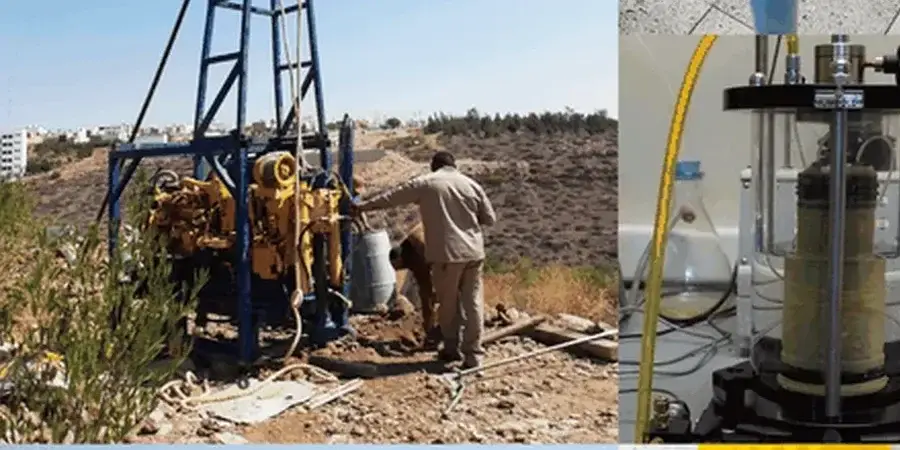
Process overview

Dublin sits at roughly 20 metres above sea level, but its subsurface tells a different story: post-glacial alluvium, Irish Sea till, and pockets of loose limestone-derived gravels that can settle unevenly under load. With nearly 1.5 million people in the Greater Dublin Area, the pressure to build on marginal land has grown sharply—warehouses near Clondalkin, apartment blocks in Docklands, and school extensions in Tallaght all encounter these variable deposits. Vibrocompaction design in this context means translating site-specific CPT logs into a grid spacing that guarantees a relative density above 70 percent. We specify the vibrator power—usually 130 to 180 kW for Dublin's granular overburden—and the lift thickness based on grain-size curves from grain size testing performed in our ISO 17025-accredited lab. The design also accounts for the water table, which in Dublin often sits within 2 metres of ground surface, affecting both the effectiveness of the vibrator and the post-treatment settlement timeline. We've found that for silty sands with fines content below 15 percent, a triangular grid at 2.5-metre centres delivers consistent densification; above that threshold, we tighten the spacing or switch to stone columns as a complementary Improvement technique.
Vibrocompaction Design for Dublin's Glacial Soils
Technical reference — Dublin

Local context

A warehouse extension in Ballymount was designed with shallow pad footings on what the preliminary boreholes described as 'medium dense gravel'. During excavation, the contractor uncovered a 3-metre-thick lens of loose silty sand right under the footprint—completely missed by the original investigation. The structural engineer called us on a Thursday afternoon; the pour was scheduled for the following Tuesday. We mobilised a depth vibrator that weekend and treated the zone with a tight 2-metre triangular grid, completing six compaction points to 12 metres depth. Post-treatment CPTs confirmed the tip resistance had tripled, and the footings were poured on schedule. This scenario repeats itself across Dublin: glacial depositional environments create abrupt lateral changes that only in-situ densification can address without redesigning the entire foundation system. Skipping a targeted ground investigation before vibrocompaction design risks leaving untreated lenses that will settle differentially under load, cracking partition walls and jamming doors within the first year of occupancy.

Need a geotechnical assessment?

Reply within 24h.

Email: [email protected]

Reference standards


Eurocode 7: EN 1997-1:2004 (Geotechnical design), ISO 22476 series (CPT and PMT for verification), ASTM D4253/D4254 (Maximum and minimum index density), I.S. EN 1998-5:2005 (Eurocode 8, Part 5: Foundations, retaining structures)

Technical data

ParameterTypical value
Vibrator power range130–180 kW electric
Typical treatment depth8–25 m below ground level
Target relative density>70% (Dr per ASTM D4253/D4254)
Grid patternTriangular, 2.0–3.0 m centres
Lift thickness0.5–1.0 m per step
Maximum fines content<15% for optimal densification
Post-treatment verificationCPT, PMT, or sand cone

Common questions


What types of soil in Dublin respond best to vibrocompaction?

Clean sands and gravels with fines content below 15 percent are ideal. The glacial outwash deposits found along the M50 corridor and in the lower Liffey valley—typically loose, saturated, and granular—densify efficiently under vibration. Silty sands with up to 20 percent fines can still be treated, although the grid spacing needs to be reduced. Cohesive soils like the Dublin black boulder clay do not respond to vibrocompaction and require alternative techniques such as stone columns or preloading.

How do you verify that the ground has been adequately compacted?

We run CPT soundings at the centroid of each grid triangle before the vibrator arrives and again 24 to 48 hours after treatment. A minimum doubling of cone resistance is our internal benchmark for loose sands, though the acceptance criteria are project-specific and defined in the design report. For gravelly soils, we use sand cone density tests or pressuremeter tests. All verification data are compiled into a signed compliance document referencing Eurocode 7 and the project specification.

How much does vibrocompaction design cost for a typical Dublin site?

For a standard commercial or residential plot in the Dublin area, a vibrocompaction design package—including desktop review, grid layout, and verification protocol—ranges from €1,270 to €4,160 depending on the treated area, depth, and number of CPT verification points required. Larger industrial sites with complex stratigraphy fall at the upper end of that range.

What depth can vibrocompaction reach in Dublin's ground conditions?

With the electric vibrators we operate, 25 metres is the practical maximum in Dublin's granular deposits. Most commercial projects treat between 8 and 15 metres, which covers the influence zone of pad footings and raft foundations. Deeper treatment is feasible but requires a crane with sufficient line pull and careful monitoring of amperage to ensure the vibrator does not stall in denser till layers.

Location and service area

We serve projects across Dublin and surrounding areas.

View larger map
er>