Geotechnical Engineering
DUBLIN
HomeFoundationsShallow Foundation Design for Dublin’s Glacial Till and...

Shallow Foundation Design for Dublin’s Glacial Till and Made Ground

Site investigations you can build on.

LEARN MORE

The most expensive mistake on a Dublin site is assuming uniform bearing capacity across glacial till. A 2023 review by the Institution of Engineers of Ireland noted that over 40% of excessive settlement claims in the Greater Dublin Area originated from undetected lenses of soft clay within the till. These lenses are common in the northern suburbs, from Santry to Swords, where the till interface with underlying limestone can be erratic. A shallow foundation design that ignores these local variations fails before the superstructure is even loaded. Our approach maps the bearing stratum at close intervals, often combining test pits for visual logging of the weathered rockhead with grain-size analysis to confirm drainage characteristics directly beneath the footing zone. The result is a design that works with Dublin's geology, not against it.

In Dublin's glacial till, a 50 kPa difference in allowable bearing pressure can mean the difference between a standard strip footing and an expensive raft.
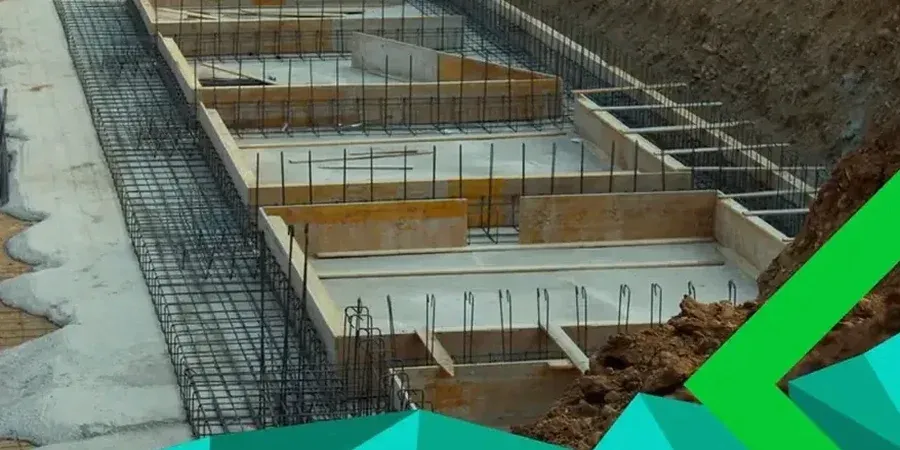
Process overview

The site investigation for a shallow foundation in Dublin typically starts with a JCB 3CX backhoe or a tracked excavator fitted with a 600 mm bucket. In tight-access mews lanes behind Rathmines or Ranelagh red-brick terraces, a micro-excavator is the only practical option. The operative sequence is straightforward: strip the made ground, expose the natural till, and log the depth to the Dublin Boulder Clay. The crew runs dynamic cone penetration tests every 1.5 m along the trench line to catch lateral changes in density. If the till is grey-black and fissured, it is the Upper Till; if brown and stony, the Lower Till. The difference matters for bearing capacity. A CPT test pushed to refusal gives a continuous profile of tip resistance and sleeve friction, removing the guesswork from the selection of the bearing stratum. All logging follows IS EN ISO 22475-1, with samples bagged for laboratory index testing back at the accredited facility.
Shallow Foundation Design for Dublin’s Glacial Till and Made Ground
Technical reference — Dublin

Local context

Dublin's mean annual rainfall of 758 mm, concentrated between October and January, creates a seasonal groundwater fluctuation of up to 1.5 metres in the shallow gravels overlying the till. A footing designed for dry conditions in August faces a completely different effective stress regime by December. The city also sits in a low-to-moderate seismicity zone; IS EN 1998-1 classifies Dublin as a low-hazard area, but the soft alluvial deposits along the Liffey quays and the Dodder river warrant a site-specific liquefaction assessment when the foundation depth is less than 3 metres. Ignoring the seasonal water table during a shallow foundation design leads to bearing capacity reduction and differential settlement that manifests as cracking in the masonry within the first two winters. We run undrained shear strength tests on remoulded till samples at natural water content to bracket the worst-case scenario for the design.

Need a geotechnical assessment?

Reply within 24h.

Email: [email protected]

Reference standards


IS EN 1997-1:2005 (Eurocode 7: Geotechnical design – Part 1: General rules), IS EN 1997-2:2007 (Eurocode 7: Ground investigation and testing), IS EN ISO 22475-1:2006 (Geotechnical investigation and testing – Sampling methods), IS EN 1990:2002+A1:2005 (Basis of structural design – Irish Annex NA)

Technical data

ParameterTypical value
Typical bearing stratum in Dublin city centreUpper/Lower Glacial Till (Dublin Boulder Clay)
Design codeIS EN 1997-1:2005 + Irish National Annex
Load and Resistance Factor DesignDA1 (Combination 1 & 2) per Irish Annex
Minimum footing embedment (frost)450 mm below finished ground level
Typical allowable bearing pressure (till)150–250 kPa (subject to settlement check)
Sampling standardIS EN ISO 22475-1 Category B and C
Settlement analysis methodElastic half-space (Schmertmann) or oedometric (Janbu)

Common questions


What is the typical cost of a shallow foundation design report for a Dublin residential extension?

For a standard single-storey rear extension in Dublin, the report ranges from €1.530 to €2.480. The fee covers the site visit, trial pit excavation, laboratory testing, and the signed design certificate. Sites with difficult access or deeper made ground push the cost toward the upper end.

How deep do footings need to be in Dublin to avoid frost heave?

The Irish National Annex to Eurocode 7 specifies a minimum embedment depth of 450 mm below finished ground level for frost protection. In practice, we often go to 600 mm in the Dublin suburbs because the top 150–200 mm is usually disturbed made ground with organic content. The depth is confirmed by the trial pit log, not assumed.

Which Eurocode combination governs shallow foundation design in Ireland?

The Irish National Annex mandates Design Approach 1 (DA1) for shallow foundations. This means we check both Combination 1 (A1 + M1 + R1) and Combination 2 (A2 + M2 + R1). The more onerous of the two governs the footing width. For Dublin Boulder Clay, Combination 2 usually controls the design because of the partial factor on the undrained shear strength.

Can you design a shallow foundation on Dublin's made ground without removing it?

Yes, but only if the made ground is properly characterised. We need at least three trial pits and dynamic probing to confirm the fill thickness and consistency across the footprint. If the fill is granular and has been in place for more than 10 years, we can sometimes treat it as a bearing stratum after compaction and verification. If it contains organic material or variable brick rubble, we specify a full replacement with engineered fill.

Location and service area

We serve projects across Dublin and surrounding areas.

View larger map