Geotechnical Engineering
DUBLIN
HomeLaboratoryEnsayo Proctor (Normal o Modificado)

Proctor Testing (Standard & Modified) in Dublin

Site investigations you can build on.

LEARN MORE

A recent residential project off the N11 near Stillorgan ran into trouble with fill settlement six months after handover. The contractor had placed granular fill without a compaction specification, assuming the local gravelly tills would densify under traffic. The problem was moisture. Dublin's glacial tills can hold water unexpectedly, and without a defined moisture-density relationship, achieving uniform compaction is guesswork. That is where the Proctor test becomes the starting point for any earthworks specification. By establishing the relationship between moisture content and dry density for a specific borrow source, the test gives site teams a clear target. In our experience across Dublin, from Tallaght to Balbriggan, a properly executed sand cone density field check paired with a laboratory Proctor curve prevents exactly this type of post-construction settlement.

A Proctor curve is not just a lab number; it is the compaction fingerprint of a specific borrow source, and in Dublin's patchy glacial geology, that fingerprint changes fast.
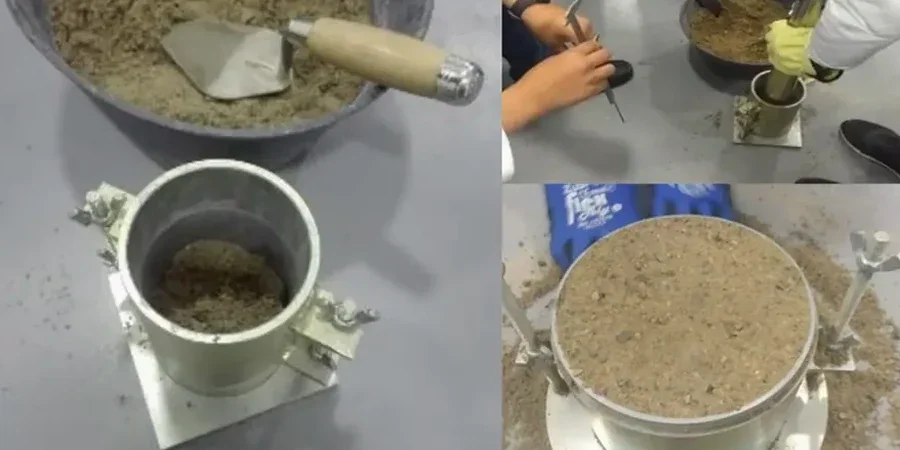
Process overview

What we see regularly in the Dublin region is that the natural boulder clay—the lodgement till that underlies much of the city—has a fines content that varies dramatically over short distances. A Proctor test on material from a cut in Sandyford can give a markedly different optimum moisture content than material from a cut just a kilometre away in Dundrum. The standard Proctor (BS 1377-4 / I.S. EN 13286-2) uses a 2.5 kg rammer dropped 300 mm, compacting soil in three layers. For heavily loaded pavements or airfield works, the modified Proctor (BS 1377-4 / I.S. EN 13286-2) applies a 4.5 kg rammer dropped 450 mm in five layers, better replicating the compactive effort of modern vibratory rollers. We often combine results with grain size analysis to understand why a material shifts its OMC, particularly when the silt fraction exceeds 15%. The test itself is straightforward, but interpreting the curve for Dublin's variable glacial deposits requires local experience—especially when the peak of the curve is flat, which can happen with well-graded sandy gravels from the Esker Riada deposits west of the city.
Proctor Testing (Standard & Modified) in Dublin
Technical reference — Dublin

Local context

The risk profile differs between Dublin's northside and southside suburbs. North of the Liffey, in areas like Finglas and Ballymun, the till cover is often thinner and sandier, with less plasticity. OMC values tend to be lower, and the margin for error on the wet side of optimum is narrow—add too much water and the fill becomes unstable quickly. South of the city, around Dún Laoghaire–Rathdown, the tills are frequently more clay-rich, with OMC values that can be higher and compaction curves that are more forgiving on the wet side. The common failure mode we investigate is under-compaction of service trench backfill in road corridors. Dublin City Council and TII specifications mandate minimum relative compaction values (typically 95% Standard Proctor for general fill, 98% for capping layers), but without a site-specific Proctor reference, nuclear gauge readings become meaningless. A CBR road test tied to the same Proctor reference density is standard practice for pavement design in the Greater Dublin Area.

Need a geotechnical assessment?

Reply within 24h.

Email: [email protected]

Visual overview


Reference standards

BS 1377-4:1990 (Compaction-related tests), I.S. EN 13286-2 (Standard Proctor), I.S. EN 13286-2 (Modified Proctor), TII Specification for Road Works (Series 600 Earthworks), IS EN 13286-2:2010 (Proctor for unbound mixtures)

Technical data


ParameterTypical value
Test standard (Standard Proctor)BS 1377-4:1990, I.S. EN 13286-2
Test standard (Modified Proctor)BS 1377-4:1990, I.S. EN 13286-2
Rammer mass (Standard)2.5 kg
Rammer mass (Modified)4.5 kg
Drop height (Standard)300 mm
Drop height (Modified)450 mm
Mould diameter105 mm (or 152 mm for coarse soils)
Typical OMC range (Dublin till)8% to 14%
ReportingDry density vs. moisture content curve, OMC, MDD

Common questions

How much does a standard Proctor test cost in Dublin?

A standard Proctor test (BS 1377-4 or I.S. EN 13286-2) typically costs between €100 and €140 depending on sample preparation requirements. A modified Proctor test (I.S. EN 13286-2) ranges from €170 to €220. For projects requiring multiple compaction curves from different borrow sources, we provide package pricing based on the total number of tests.

Which Proctor test do I need for a Dublin City Council road opening permit?

Dublin City Council and most county councils require a minimum of 95% relative compaction referenced to the standard Proctor (BS 1377-4) for trench reinstatement in footways and carriageways. For heavily trafficked roads, the specification may call for 98% standard Proctor or a modified Proctor reference. Always check the specific permit conditions for the street.

How long does a Proctor test take from sample collection to results?

A single Proctor compaction test, from sample preparation through to the final curve, typically takes two to three working days. The test requires careful moisture conditioning of the sample, which cannot be rushed. For time-sensitive earthworks, we can provide a preliminary OMC within 24 hours using rapid methods, with the full certified report following the next day.

Location and service area

We serve projects across Dublin and surrounding areas.

View larger map
body>