Geotechnical Engineering
DUBLIN
HomeIn-SituDensidad de campo (cono de arena)

Field Density Testing in Dublin – Sand Cone Method for Compaction Control

Site investigations you can build on.

LEARN MORE

The geological contrast between Dublin's southside and northside is something you learn to respect on the ground. South of the Liffey, where granite bedrock rises toward the Dublin Mountains, weathered till often gives way to stiff boulder clay that compacts predictably but demands careful moisture control. Across the river, the alluvial deposits and darker limestone-derived tills present a different challenge—layers that can look firm at surface but hide loose pockets where the Dodder and Tolka historically shifted course. For any earthworks contractor, this means one thing: you cannot trust visual inspection alone. A sand cone density test run at the right depth tells you whether that lift meets the 95% or 98% relative compaction your specification requires, and it does so with a direct physical measurement that no nuclear gauge reading can dispute when the resident engineer asks for proof.

A sand cone test gives you a volume measurement you can see and a density number you can defend—no calibration drift, no radiation permit, just straightforward physics.
Process overview

One thing our field technicians note almost every week on Dublin sites: the sand cone method performs far more consistently than nuclear density gauges in the mixed glacial tills common from Tallaght to Balbriggan. The principle is straightforward—a test hole is carefully excavated, all removed soil is weighed, and the hole's volume is measured by filling it with a uniformly graded sand of known density. But the execution requires discipline. The base plate must sit flush on an even surface, the excavation cannot disturb sidewalls, and the calibration of the Ottawa sand has to be checked against the site's vibration environment. Our lab maintains ISO 17025 accreditation for the supporting Proctor compaction curves, and every field density result we issue references the specific standard—whether that is BS 1377-9 for method detail or the Specification for Road Works Series 600 for acceptance limits. We also cross-check problematic results with Atterberg limits when the fines content suggests sensitivity to moisture variation.
Field Density Testing in Dublin – Sand Cone Method for Compaction Control
Technical reference — Dublin

Local context

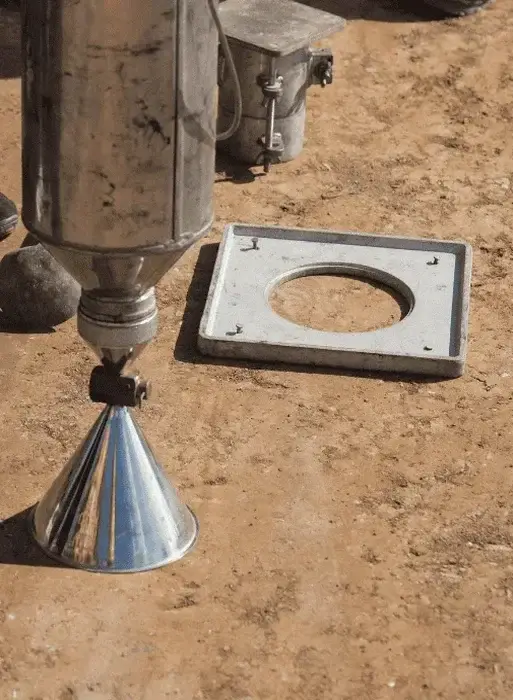
A Dublin contractor we work with regularly had a car park sub-base fail inspection on a project near the M50 upgrade because the specified compaction was never verified beyond the top 150 mm. The sand cone equipment—a simple double-cone assembly with a one-gallon jar and a calibrated base plate—was brought in after the fact. When we excavated through the apparently solid crushed rock, the underlying layer tested at barely 88% of modified Proctor maximum dry density. The jar's valve was opened, the calibrated sand from Ottawa flowed into the cavity, and the volume calculation left no room for argument. Rework cost them three weeks. On current jobs, we integrate field density checks from the first lift onward, correlating results with Proctor reference curves established in our accredited lab to avoid exactly that kind of delay. In Dublin's damp climate, waiting until the final layer to test is a risk no programme budget should carry.

Need a geotechnical assessment?

Reply within 24h.

Email: [email protected]

Reference standards


BS 1377-9:1990, IS EN 13286-2:2010, NRA Specification for Road Works (SRW) Series 600, ISO 17025 (lab accreditation)

Technical data

ParameterTypical value
Reference standard (test method)BS 1377-9:1990 (sand replacement)
Reference standard (compaction)BS 1377-4 / IS EN 13286-2
Typical test depth100–200 mm per lift
Calibration sandGraded Ottawa 20–30 (single-size)
Base plate diameter150–300 mm depending on max particle size
Acceptance criteria (roads)≥95% max dry density (sub-base), ≥98% (capping)
Typical volume excavated800–1500 cm³

Common questions


What does a field density test cost in Dublin?

Our standard sand cone density test costs between €100 and €120 per test point, depending on site location within the Dublin area and the number of points required on a given day. If Proctor reference curves need to be developed in the lab first, that is quoted separately based on material type.

When is the sand cone method preferred over a nuclear gauge?

The sand cone method is preferred when the material contains significant aggregate or cobble content that would distort a nuclear gauge reading, on sites where radiation permits are impractical, or when a dispute requires a direct physical measurement. Dublin's glacial tills, with their erratic particle sizes, often fall into this category.

How many tests are needed for a typical Dublin car park or building pad?

Frequency depends on the specification—NRA Series 600 typically requires one test per 500 m² per lift for roads, while building pads under BCAR may require a grid of points at the engineer's discretion. We review the spec with you before mobilising and recommend a pattern that satisfies the resident engineer without oversampling.

Location and service area

We serve projects across Dublin and surrounding areas.

View larger map